Julius Csizmazia, Founder, UNLEARN LEADERSHIP
Execution Architecture for Senior Leadership Teams
Your plan is behind.
Decisions stall.
Bad news arrives late.
I find the cause. Then I install the structure.

Julius Csizmazia, Founder, UNLEARN LEADERSHIP
Your plan is behind.
Decisions stall.
Bad news arrives late.
I find the cause. Then I install the structure.
You underwrote a plan the whole leadership team agreed to. A few quarters in, the number's behind — and no one can quite say when it slipped.
That gap has a name and a price. I call it the Invisible Tax — the EBITDA your plan loses to how the leadership team behaves under pressure.
That space has a structure. I make it visible, and I install the operating conditions that hold execution together when the pressure comes.
I take on a few leadership teams a year.
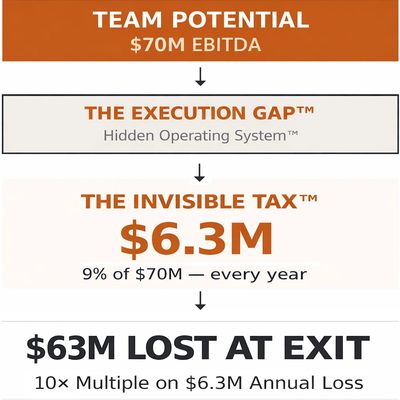
Modeled on a $70M company. Scale it to yours.
That is the detective's question. It produces a name in twenty minutes and the same failure again in five months. Once a name is attached, the work stops. Nothing got fixed, because nothing was found. A person was found.
The architect asks what the system produced. What had to be true about how you decide, who owns what, and what reaches you and when, for a competent adult to make that call and believe it was reasonable at the time?
That question is slower. It ends in a finding, and a finding has an owner and a deadline. A name has neither.
The five traps below are what the architect finds when he asks it.

Same failure. Two questions. Only one of them produces something you can assign.
The Fear Trap — Diligence overextends into Control.
Every decision routes through one person who won't let go.
The Expert Trap — Competence overextends into Certainty.
Your sharpest leader can no longer be told he's wrong.
The Ego Trap — Ambition overextends into Competition.
Your best people compete with each other instead of the market.
The Silence Trap — Empathy overextends into Avoidance.
Bad news reaches you too late to act on it.
The Fog Trap — Flexibility overextends into Chaos.
Ask six leaders to name the one priority and you get six answers.
Which one runs your team? Take the Five Traps Diagnostic →

Under pressure, each strength on the left becomes the trap on the right.
Senior leadership teams arrive with strategy — financial models, value creation plans, hundred-day decks, board commitments.
What rarely arrives with them:
Those four carry the plan across the Execution Gap — the distance between the plan and the results. Nothing reaches results without passing through them.
Under pressure, the traps push back on all four.
The four hold their shape. They never remove the traps — the biology stays. The plan keeps moving while the pressure keeps arriving.

Every trap presses on the same path the plan has to travel.
Julius wrote the book and installs the work himself. Thirty years inside enterprise leadership teams is where the five patterns came from and where the structure was built.
He runs the Diagnostic in the room with the team, builds with the CEO, and stays through the Ratchet. One person does the work, start to finish.
Yale, biology. MS in Management, National-Louis University. Based in Jacksonville, Florida, and works on site wherever the leadership team sits.

Julius Csizmazia. THE INVISIBLE TAX: Execution Architecture.
1. The Diagnostic
One to two days on-site with the CEO and the team. I watch how the leadership team operates under pressure, name which of the Five Traps runs your team, and produce the design basis for what gets installed. If the Diagnostic shows I can't get the cooperation the install needs, I'll say so and decline the Build.
2. The 90-Day Build
I install the operating architecture on-site: a Single Overriding Priority, Decision Rights at the escalation points, a weekly cross-functional cadence, and a Designated Dissenter at every major decision. Truth becomes the path of least resistance. Hiding it becomes the risk.
3. The Ratchet
The Ratchet locks the gains and blocks reversion — so the standard holds through leadership change, ownership transition, and exit, and keeps running without me in the room.

Only the third one has no end date.
Start on your own. The Five Traps Diagnostic runs here on this site. You rank a set of statements about how your leadership team behaves when the pressure arrives, and the report reaches your inbox as a PDF: which of the five traps runs your team, and where it surfaces.
TAKE THE FIVE TRAPS DIAGNOSTIC →
Start with me in the room. Every installation opens with the on-site Diagnostic, one to two days with the CEO and the leadership team, watching where decisions stall.
Why an outside Architect. An Architect means someone outside the company who installs this work for a living. Everything I install is in the book, and some leaders build it from there and it holds. The difference is what the install runs on. Built from inside, it runs on the leader's willpower — and pressure spends willpower before it spends anything else. Three places it gives way.
Speed. The Build runs on a fixed ninety-day clock, with my fee and the board's attention attached to it. A self-install has no clock. The urgent outranks it every week, and the finish line keeps moving until the program quietly stops.
Collision Detection. The pressure behaviors that break a leadership team hide from the people running them. A CEO whose default runs on control believes he maintains standards. Someone outside the pattern sees what the person inside it cannot.
Holding the Line. Pressure cancels the review, and it feels responsible in the moment: the quarter is at risk, the team is stretched, and it looks like the one meeting the company can afford to lose. That is a trap setting the calendar. I hold that line through the ninety days. Then it transfers. We name a System Steward and two alternates inside your company, leaders who carry an explicit mandate to protect the standard against anyone senior enough to cut a corner. The Steward runs a ten-question audit on the first business day of each month and reports the score to the CEO, and in a sponsor-backed company to the Operating Partner. That score, plus the Ratchet, holds the line after I leave.
How it starts. Before any of that, we talk. Tell me where decisions stall in your company, and I'll tell you whether this work fits. Sometimes it doesn't, and I'll say so on the call.
Phone: (904) 955-4022

On your own, the install runs on willpower. In the room, it runs on structure.